Amarnath Praful
In this essay, I share excerpts from my research at the Victoria & Albert Museum (V&A) photography collection. This study was undertaken during the Curatorial Research Fellowship at the Photography Department of the V&A South Kensington from April to October 2025. In its broadest framework, my project attempts to interpret, engage and contextualise the photography history of the Indian subcontinent through Ocean as Method. This proposal was tested out through careful looking and reading of photographic objects in the photography collection of the V&A (the research focused on colonial photography dated between c.1840 and 1940). I sought to identify telling patterns and comparable narratives by borrowing ideas and frameworks from both photography theory/history and Indian Ocean studies.
Thus, the first section introduces the speculative crossovers between the disciplines of photography history and ocean studies, especially in the context of colonial histories of the Indian Ocean. The second section stages examples from three different interconnected sites: the anatomy of seascape as a peculiar category in the history of the medium; the ship as icon, architecture and spectacle in the order of colonial photography; and, most importantly, the civil contract of photographs concerned with maritime citizenry, public infrastructures and caste hierarchies in port cities of India. Through these two sections, I seek to foreground the question: What does it mean to think ‘with’ the ocean?
I. Notations
Thinking ‘with’ the Ocean
Philip Steinberg and Kimberley Peters, in their introductory text “Wet Ontologies, Fluid Spaces,” reference pilot and journalist William Langewiesche as he notes: “Since we live on land and are usually beyond the sight of the sea, it is easy to forget that our world is an ocean world. Geographically it is not the exception, but the greatest defining feature of our planet.”1 We have been prone to terrestrial imaginations, with the ocean on the margins of our thoughts. What does it mean to invert this? What does thinking oceanically mean?
In the book Ocean as Method: Thinking with the Maritime, Dilip Menon, Nishat Zaidi, Saarah Jappie and Simi Malhotra use frameworks from Renisa Mawani’s (2018) and Isabel Hofmeyr’s (2012) work to articulate Ocean as Method.2 This approach takes into consideration the fluid volume and vertical depth of the ocean (terra infirma) as opposed to a cartographic horizontality which measures the distance of the land. Their formulation of Ocean as Method deploys generally two different methodologies, namely thinking ‘from’ the ocean and thinking ‘with’ the ocean.
Thinking ‘from’ the ocean allows one to consider the modalities of the underwater world to articulate phenomena of the planetary whole. It serves as a counterintuitive proposition to methodologies of land being adapted in order to make sense of the ocean. On the other hand, thinking ‘with’ the ocean is proposed as an amphibious approach and a perspective in which land and water are connected. Thinking ‘with’ the ocean holds together the land, the littoral and the horizontal terrain of the ocean navigated by humans. It calls for a radical and just rearticulation of histories that have been anxiously charted through terrestrial and cartographic imaginations, rigidities of land, borders and acquisitions. It seeks to unsettle static, bordered and linear framings that typify human geographical studies of place, territory and time. Thinking ‘with’ the ocean allows one to consider various materialities of technology, which can never be separated from either the experience(s) of the ocean or the meaning(s) that we attach to them. In “Wet Ontologies, Fluid Spaces,” Steinberg and Peters draw from a Lagrangian3 perspective to remind us that movement is not subsequent to geography; rather it is the foundation of geography.4 Thus, the world is constituted by mobility.
Furthermore, thinking ‘with’ the ocean diffuses and blurs historical imaginations hoisted by the premise and infrastructure of the nation state (which is largely a 17th–18th century invention). It essentially deterritorialises or destabilises ideas of direction, periphery, centre, boundary and terrestriality by challenging the perception of territory as political technology. It complicates notions of the colonial matrix proposed by the eminent Peruvian scholar Aníbal Quijano.5 One is thus compelled to move beyond the binaries of colonisers–colonised and into a more cosmopolitan ocean world. Menon in the book Ocean as Method: Thinking with the Maritime proposes and develops the idea of the ‘paracolonial’, wherein bodies, objects and narratives that circulated within the flux of the ocean have to be read beyond precolonial, colonial and postcolonial linearities.6
Oceanic narratives often concern themselves with visions of horizons, views of ‘endlessness’, the seafarer’s vision of the shore, chimeras and mythical apparitions. Maritime voyages made the appearance of objects, bodies and material from a previously disconnected world possible. In the oceanic, there is constant flux as opposed to sedimentation—continuity, persistence and circulation all come to the foreground. The idea of citizenship, the social episteme of bodies at sea and the legacies and aftermaths of paracolonial systems demand a seasick reading of the collections. I interpret paracolonial as a system that can imbibe and facilitate thinking around some of the internal colonial structures in South Asian society.
…thinking ‘with’ the ocean diffuses and blurs historical imaginations hoisted by the premise and infrastructure of the nation state…It essentially deterritorialises or destabilises ideas of direction, periphery, centre, boundary and terrestriality…
While on the one hand, there is emerging scholarship within ocean humanities that attests to the distinct histories and contexts of the Indian, Atlantic and Pacific oceans; on the other hand, there is also scholarship that dislodges/rejects the cartographic division of the ocean into these divided territories. The latter offers a unified perspective of the ocean as a continuum. The emerging field of Indian Ocean studies, led by scholars from diverse disciplines (anthropology, history, economics, literature, social sciences, law, marine biology, etc., to name a few), offers a varied perspective of ocean humanities to understand historical, contemporary and futuristic phenomena. Often it is the histories of migration, labour and travel that dispel and reimagine oceanic thought. Reflecting on this through my work at the V&A photography collection, one of the central questions I found myself returning to was: How do the two seemingly diagonal forces of the vast history and prehistory of the ocean and the relatively new and concise history of photographic technology come together?
Seasick at the archives
The ocean is central to the history of photography, whether through its material or by aiding in dissemination. Since its inception, the medium has depended on global extraction and exploitation of natural resources. In the 19th century, salt, carbon, fossil fuels like bitumen and metals like copper and silver were widely used in salt paper prints and copper plates. In the 20th century, silver became one of the most mined minerals, with the photography industry as a major consumer. If movement is the foundation of geography, then maritime technology staged extraction from colonised nations to facilitate industrial production and consumption in and for the Global North/the West. This phenomenon is crucial to the ontology of photography.7 The histories of dissemination of photographic labour, technology, photomechanical prints, postcards and, subsequently, visual cultures were all also facilitated by the maritime. This complex network critiques the inadequate and linear narrative of the understanding that photography was invented in the West and then deployed in colonies.
In the context of the Indian Ocean, the temporal overlap between a very recent history of photography and a seemingly prehistoric idea of ocean humanities is foreshadowed by colonial trade and the British empire. Thus, the first century of photography and the last century of the British empire in India loosely come together in a temporal bracket (1840–1940). Most of the photographic objects that were part of my research lie within this time period. In my reading, I apply Ariella Aïsha Azoulay’s concept of the civil contract of photography,8 wherein the history of photography or the photographic complex belongs to the subject of history, to the unnamed and unidentified, and to the citizen descriptors of history.
If movement is the foundation of geography, then maritime technology staged extraction from colonised nations to facilitate industrial production and consumption in and for the Global North/the West. This phenomenon is crucial to the ontology of photography.
Photography history—especially in the Indian subcontinent—can be read against the grain of imperial forces, technologies, innovation, the Industrial Revolution, global labour, trade and migration. I was curious to examine the interstices and littoral areas that form when the disciplines of ocean studies and photography history thread together. Moving away from the nation state/pre-conceived templates of citizenry and terrestrial ideas of place, one was compelled to consider sites, both spatio-temporal and conceptual, where this intersection emerged from an oceanic immensity. As I encountered the vastness of the collection, I found myself submerged in the subject matter of the ocean. A persistent need to read the photographic object against the backdrop of the ocean made me ponder about being seasick. My imagination conjured up visions of being lost at sea, of trying to set up a tripod to expose a photograph from a wobbly dhow, with the terra infirma that prevents the stability required for photographic framing. Reading the images in the collection allowed me to recognise that the history of each photographic object was inextricably linked to the history of the ocean—making this predicament of seasickness acute. I began to look at the photographic objects in the V&A photography collection as empirical sites to articulate the ocean as method and as affect. The case studies and observations that I present here are not at all exhaustive or comprehensive, but rather suggestive and fragmented—with a porous and leaky framing. These examples triangulate between sites of the seascape, ship and the port city.
II. Sightings
The Seascape
The seascape has been a category in photography that typically frames the sea from the vantage point of the land. As a genre, it traces its lineage to the tradition of painting. The operative difference between painting and photography of the seascape was also perhaps that the camera had to be set up and looked at, often from the land to the sea, in order to capture what one may call a ‘seascape’. However, the painting does not imply the absence of technology in the vicinity of the sea. In fact, many accomplished photographs in the V&A collections by the likes of Paul Martin, W.J. Day, etc., were made as studies for paintings. Thus, the seascape as a visual genre emerged and was sustained through a cyclical link between photography and painting practices.
It is worth noting that the sea as a subject was often dismissed, marginalised or remained unarticulated. In Mythologies (1957), Roland Barthes called the sea a “non-signifying field” that “bears no message.”9 For Lévi-Strauss, the seascape was one of oppressive monotony and could be understood as a diluted landscape.10 Quite worryingly, Carl Schmitt observed that the sea has no character.11 The etymology of “character” can be traced back to the Greek word charassein, meaning “to sharpen, cut in furrows, or engrave,” which led to charaktēr, a noun meaning “mark, distinctive quality.” Perhaps the infinite expanse and incessant flux of the ocean, the deeply ambivalent feeling of floating on the sea, the incomprehensibility of horizon, and the urge to charter terrain and mark boundaries gave way to these anxieties. It is also possibly shadows of this anxiety that prevail in the repetitive, strict and structural anatomy of the seascape.
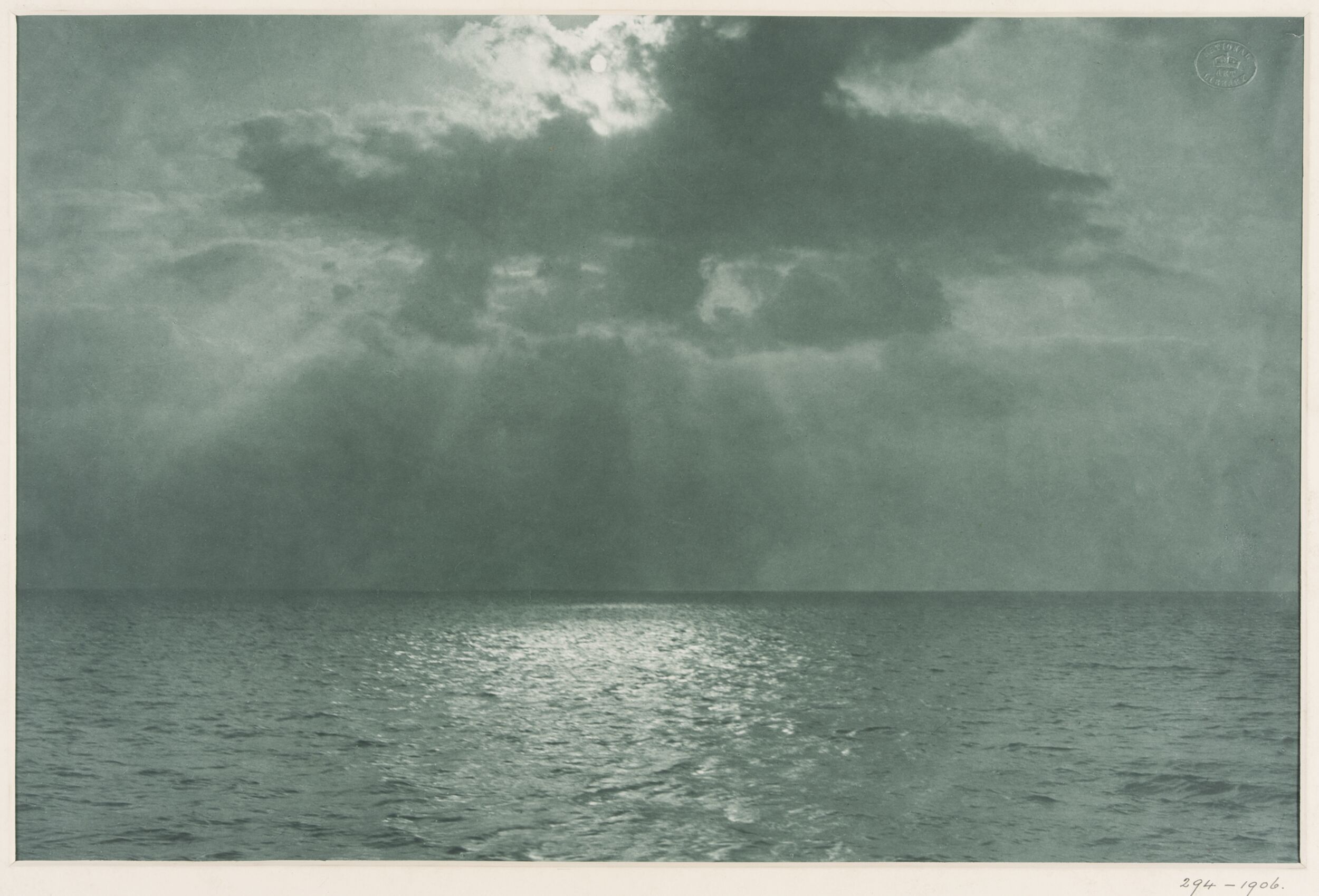
For instance, W.J. Day in his album Studies on Land and Sea notates: “Atmospheric effect at Sea. This represents a picturesque cloud in passing across the sun. The sunbeams and direct sunlight on the sea” (Fig. 1). This caption could be used by almost all the photographers in the 19th and early 20th centuries as they chased the ideal seascape—the sun setting, clouds with dramatic flair, the sea and the horizon, with the lonely ship in the foreground. This ideal photograph relieved the seascape photographer of the need to invent a subject. Instead, the seascape became a template and playground for technical explorations of the medium, often deploying painterly effects and combination printing—the most famous example being the Frenchman Gustave Le Gray’s photographs.12
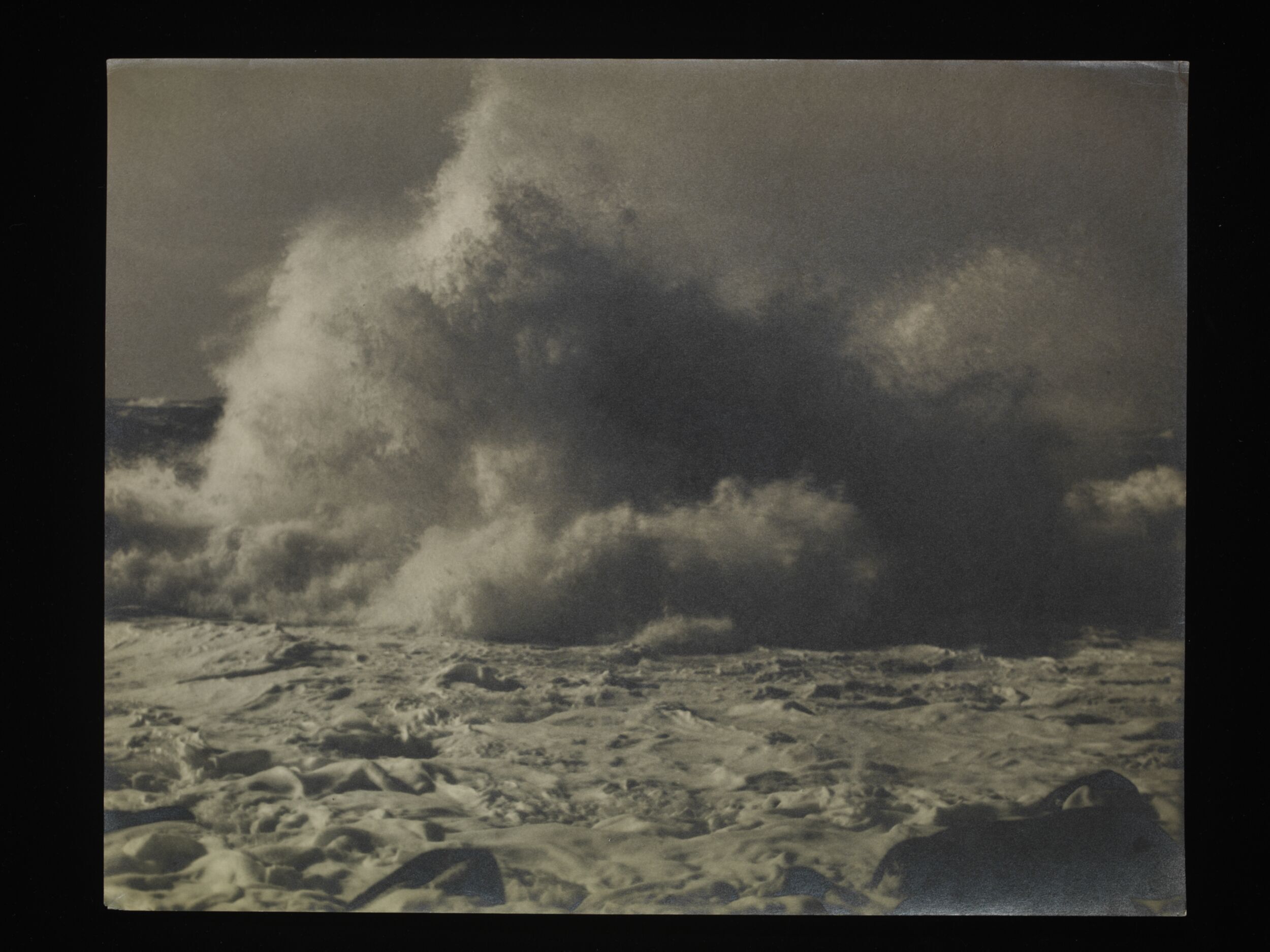
However, there are seascapes in the collection that document imagery and visions from the sea to the land. There are also littoral landscapes, as liminal spaces that hold the potential of both land and the sea. The set of photographs by F.J. Mortimer (Fig. 2) are important as they break away from the presumption that the photographs have to be composed from the land. His photographs give the illusion of being at sea. Titled with poetic expressions such as “Cradle of the deep,” “Sea thunder,” “Crescendo,” etc., they frame the sea with an economy that eliminates other elements that conventionally constitute the seascape—the sun, clouds, sky, ship and the horizon. The series highlights the decisive moment of the sea crashing against the land and the effect of the spraying waves through the granularity of the photographic carbon print.
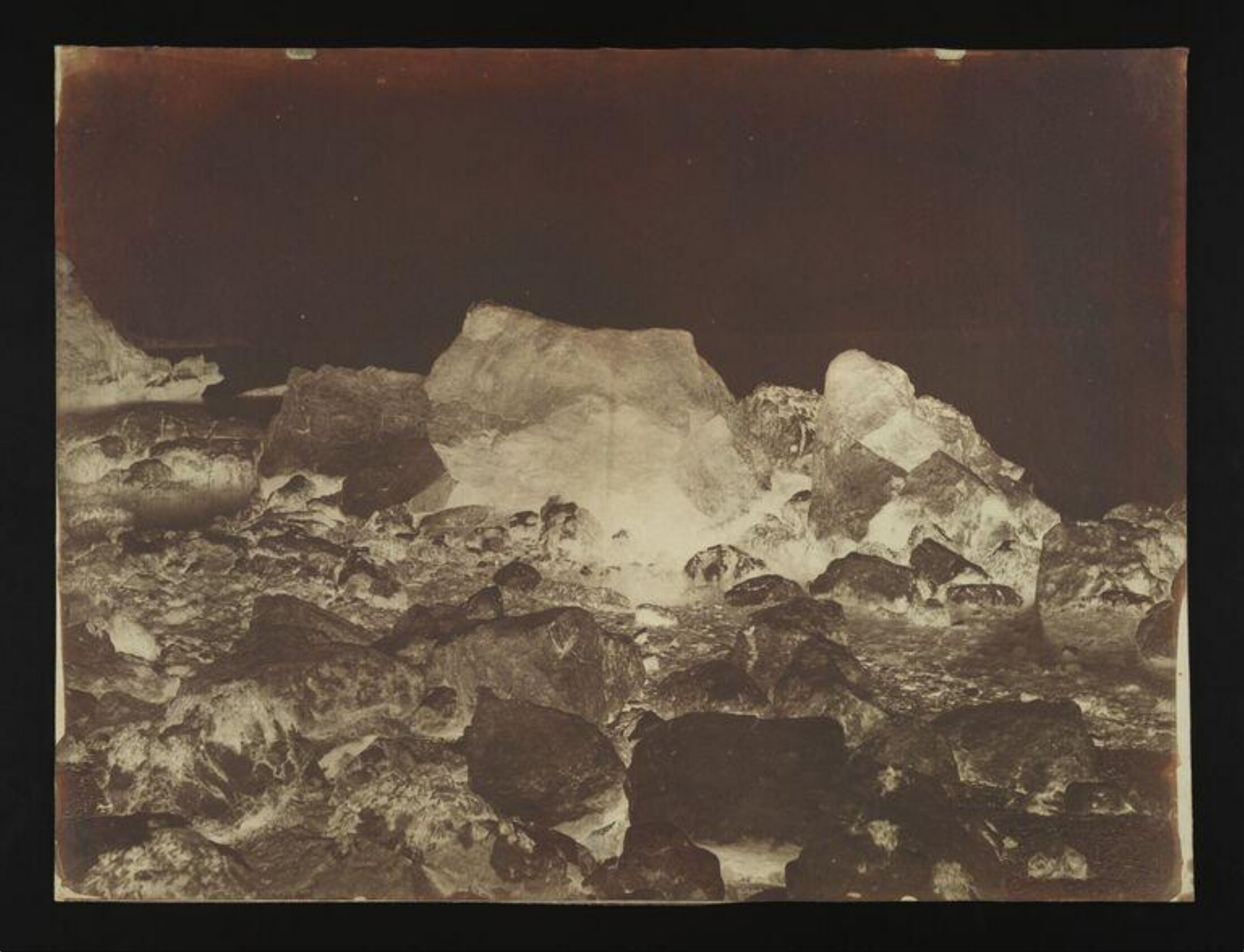
Similarly, the enigmatic set of photographs that B.B. Turner made in Torquay look back at the littoral space of the cliffs and rocks. The series depicts the granular texture of the rocks as they mingle with the texture of waves crashing upon them. Turner paints away the sky in this paper negative (Fig. 3) to emphasise the texture and form of the rocks and the beach of the coastal town.
I argue that this fixation and fascination with the seascape is premeditated by the recognition of it as a terra incognita, or the end of land, so to speak. As terra infirma, it represents an expanse with no ultimate or fixed reality, which is otherwise applicable on land. In the register of photographic encounters made from the Indian coast, the seascape does not often render itself as this unmarked site of leisure, beauty, transcendence and the sublime. Instead, the economy of images from India are layered with representations of the political territory of the colony.
Perhaps the addition of the ship in the frame of the seascape is a primary step to ascertaining the anxiety of the missing charassein/character—the mark made by the most ubiquitous floating architecture/object at sea.
Ship as architecture, metaphor and spectacle
The presence of the ship in the seascape intervenes to differentiate between the sea as a prehistoric entity residing in deep time and as a territory for anthropocentric voyages within a cartographic imagination. As architecture at sea, the ship becomes the symbol for the ocean known to humanity. It allows for the ocean to be territorialised. The ship is seen to be a heterotopia in which ideas of citizenship, location and language all attain a detached meaning.13
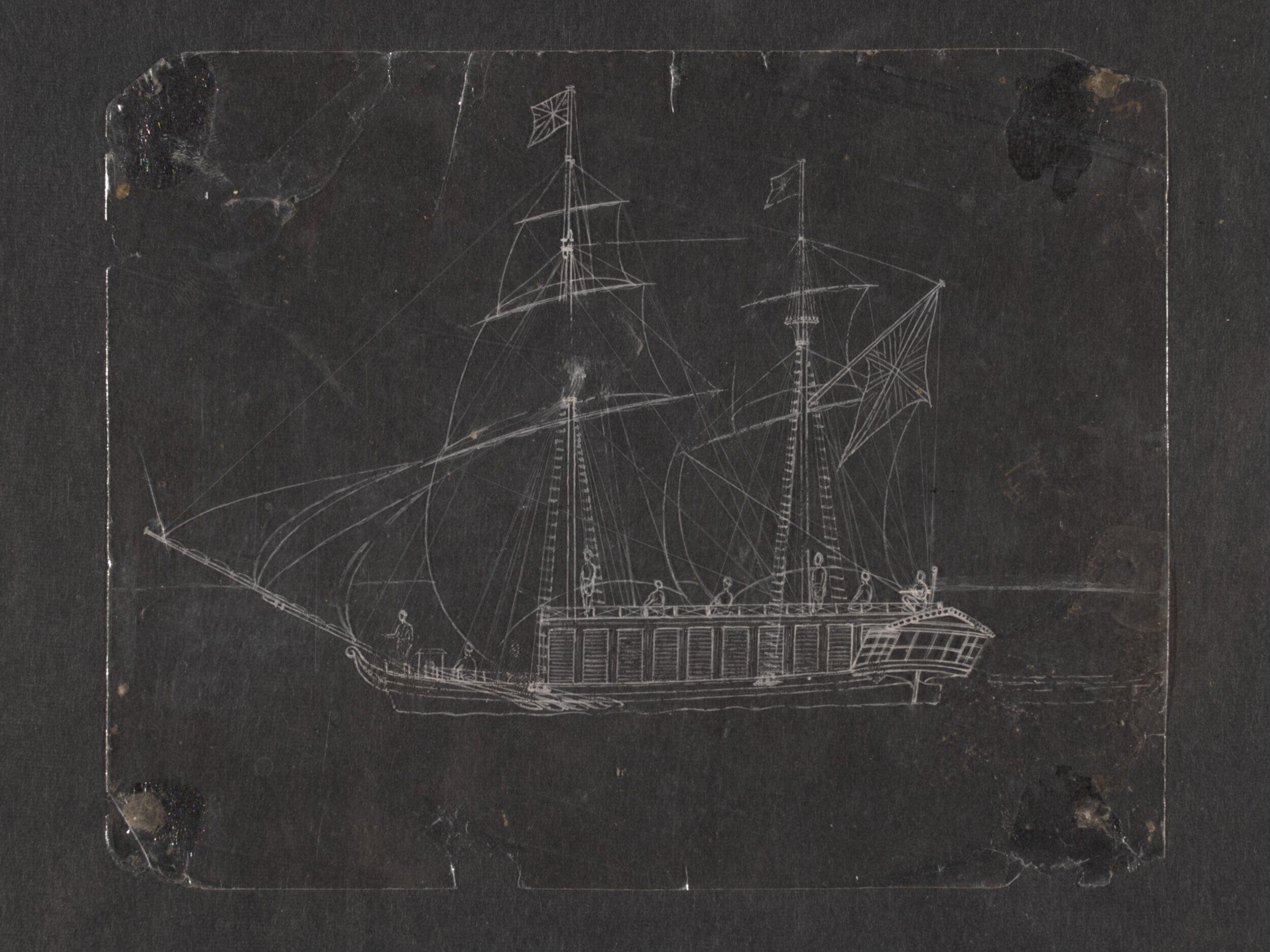
The place of the ship in the everyday colonial imaginary is apparent in a unique set of Mica paintings acquired by W.G. Archer, who served as Keeper of the Indian Section at the V&A Museum (1949–59). The set consists of sixty-three paintings that were in the custody of Ishwari Prasad, a descendant of Company painters from Murshidabad. Company painting was a distinct, hybrid and often-commissioned style of painting where the craft of miniature painting from India met subject matters of British and colonial interest. It is fascinating to see that these delicate representations of ships (Fig. 4) were placed amidst paintings depicting occupations and festivals from India!
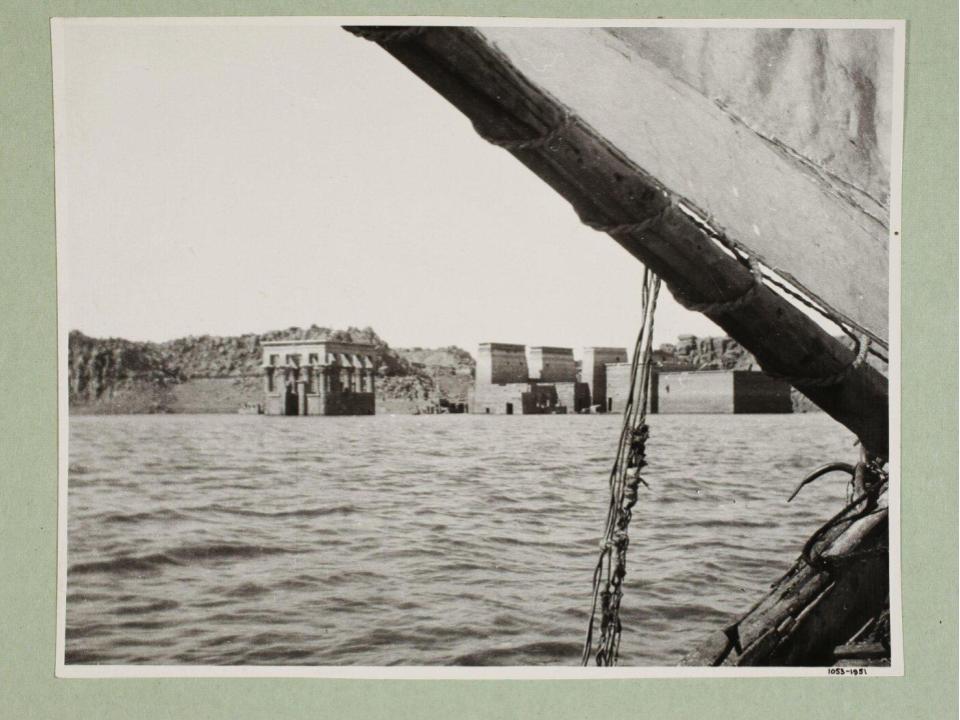
The image of the ship is a major component in the history of photography of the oceans. While the quintessential ship photograph is made from the land and frames the vessel in the sea, it is interesting to note that there have also been many instances of ships acting as darkroom architectures and vantage points from which photographs were made. In the V&A collection, we see the work of photographers like Helen Messinger Murdoch, who travelled the world and set up darkrooms in ships. Among the examples of photographs made from the ship, a photograph (Fig. 5) from Aswan, off the coast of Egypt, is peculiar—the composition foregrounds the architecture of the dhow, a traditional Arab trading vessel used centuries before the European control of the great waters. The image through the half bracket created by the sail of the dhow exposes the port city of Aswan, the Nile and the cloudless sky. It transforms the ship into the photographic frame/apparatus.
The ship emerges as a recurring motif in colonial photography. Photography and steamships contributed profoundly to the cartographic imaginations of the empire.14 There was a very vivid genre of photography in Britain that was concerned with ships specifically. Often these ship photographs used conventions of architectural photography. A prime example of this form is the work of Bedford Lemire and Co. At the V&A collections, the remarkable photographs of the Great Eastern by Robert Howlett demand closer inspection.
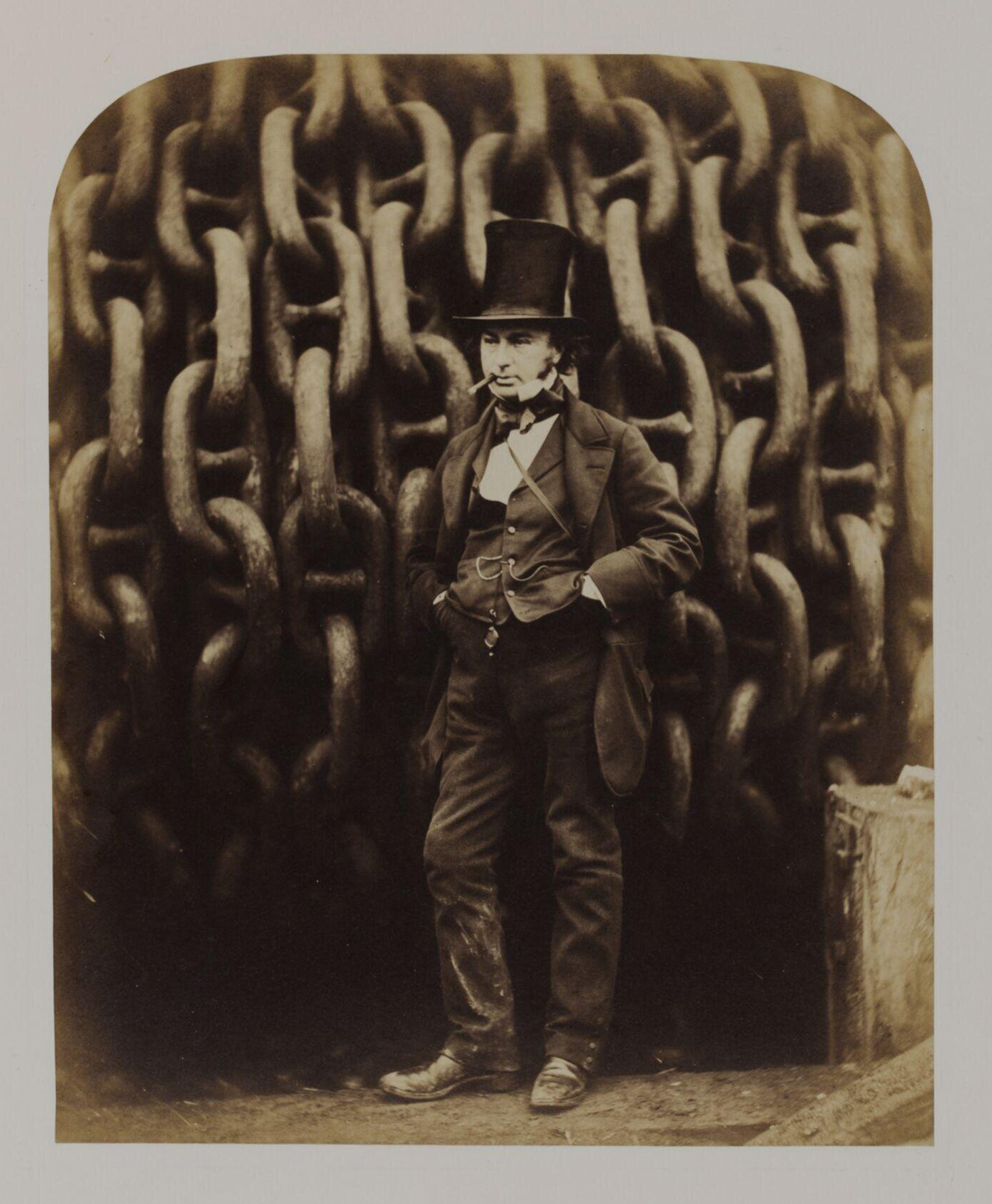
The above photograph (Fig. 6) of Isambard Kingdom Brunel exudes the Victorian ambition of the celebrated engineer who successfully oversaw the building of the Great Eastern, the largest ship on the planet at the time. My focus moves to the chains of the ship behind the engineer, which undertake an allegorical and symbolic quality. It found interesting echoes in the collection when I came across a modern tapestry piece in the V&A collection by Archie Brennan. The innovative tapestry artist from Scotland used this motif to weave one of his pieces simply titled “Chains”.
The presence of the ship in the seascape intervenes to differentiate between the sea as a prehistoric entity residing in deep time and the sea as a cartographic imagination—as a territory for anthropocentric voyage…. The ship is seen as a heterotopia in which ideas of citizenship, location and language all attain a detached meaning.
The Great Eastern was advertised as both an object to view and memorabilia. The photographs made by Howlett were widely used for lithographs and various reproductions. The ship was also the subject of music pieces such as the “Great Eastern Polka” composed by Charles Coote (1859). The steamship was often set up for public viewing—both in its early career in London as well as in later periods when it laid telegraph cables between Bombay and Aden for the British-Indian Submarine Telegraph Company. James Dugan, in his book The Great Iron Ship, remarks that “the Great Eastern when docked in Bombay port generated considerable public interest due to its huge size and was the subject of spectacle, with the captain offering tickets to view the ship for 2 rupees apiece, distributing proceeds to the crew.”15
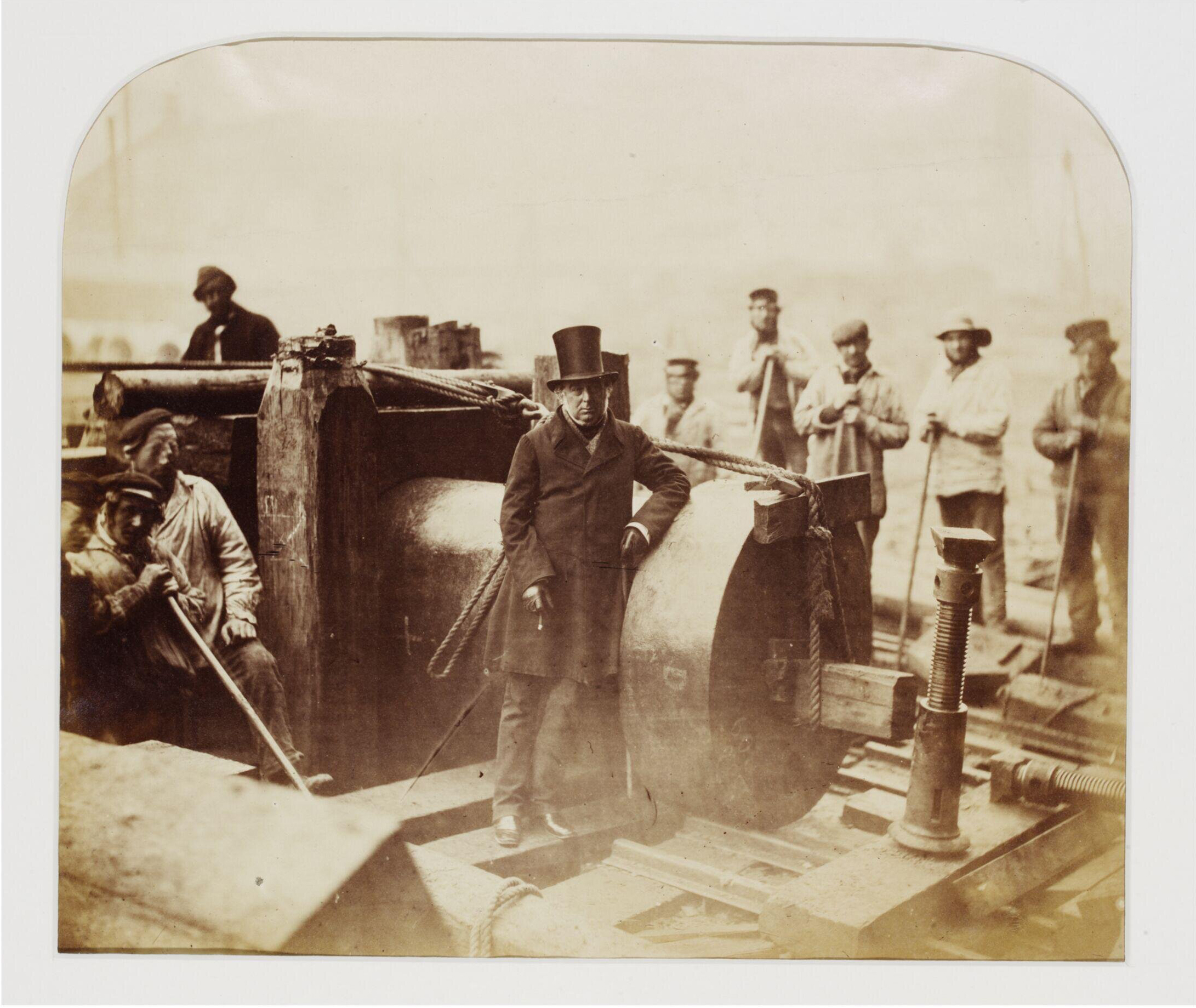
Another photograph (Fig. 7) selected from the Howlett collection shows Kingdom Brunel with (presumably) the ship’s workers gathered around. Here, the photograph focuses solely on the engineer and his apparel/stance. In doing so, it employs focus and depth of field as tools to obfuscate the workers in the background. The photograph takes on a metaphorical and sinister fiction. The image gestures to the invisible labour of the empire, aspects of bondage and class hierarchies. The workers ominously assume a pose akin to grave diggers—especially in retrospect, given the tragic ending to SS Great Eastern, as rumours abounded that a riveter had been found dead within the hull when the ship was dismantled for scrap metal in 1887. In the album, the remaining photographs show elevation views or side profiles of the Great Eastern. The gigantic iron-hulled steamship was always in the pictorial company of smaller ships, catamarans and dhows. The narrative was of power, progress and colonial ambition.
Foucault suggests that the ship is a prime example of heterotopia—a world detached from the world and a culture that dislocates but carries customs and ways of living to different shores. Extending this argument through her research on the Kutchi Gujarati dhow (smaller non-motorised vessels) which serviced various ports in the Indian Ocean, Nidhi Mahajan asserts that the ship is also a heterochronia—a space that holds together the past, present and the future.16 Mahajan argues that for the dhow sailors, time and space are felt, lived, calculated, monetised and moved through the measure of their voyage (Ghos in the Kachhi language). It connects various ports in the Middle East, India and East Africa, bringing these sites in temporal and spatial relation with each other, creating a trans-regionalism that belies national boundaries drawn on land.
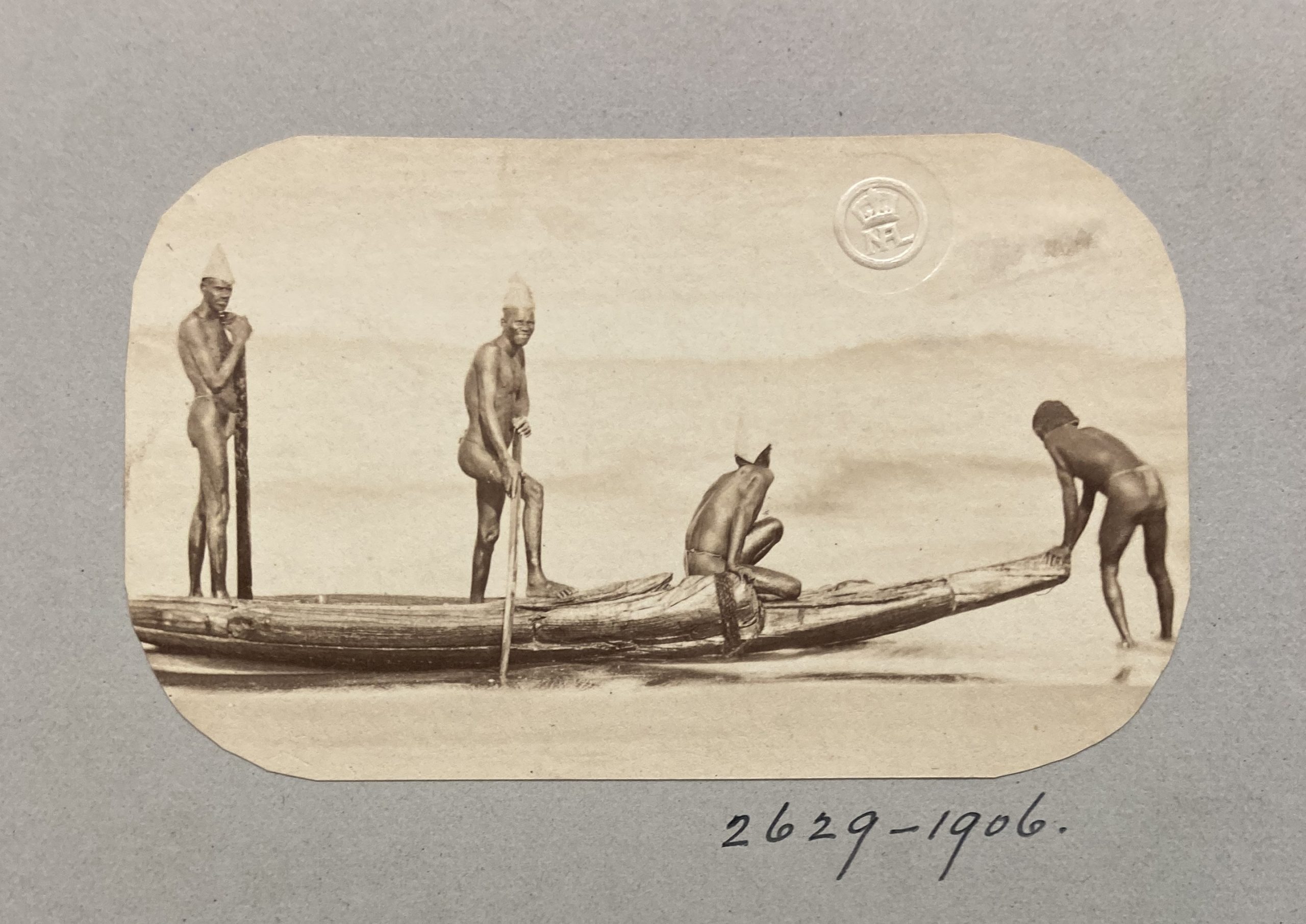
The photograph of the catamaran or the dhow was often also associated with the figure of the fishermen/boatmen. Here (Fig. 8), we see a photograph of the catamaran with four fishermen. The focus is on the figures who pose in distinct yet familiar ways in front of the colonial camera. The catamaran positions the subjects as fishermen, creating a tableau that appears without any context of either the seascape or the port. Through these various examples I have sought to complicate the relationship between the image of the ship as icon, metaphor and architecture in colonial photography. I now move to a different order of colonial architecture, namely, the port. British photographers often used panoramic techniques to depict recurrent elements such as the sea, horizon, built infrastructure, ships in the bay, and the public in the port cities of India.
Port as Portal
Photographs of ports become an important site in the attempted framing of thinking ‘with’ the ocean. What emerged from my study at the V&A photography collection was a complex set of photographic simulacra of port cities, shipbuilding, corporeal bodies of seafarers and littoral landscapes. Photographs of the port cities are underwritten with the demand for a registration of bodies, of citizenry and of the public. The ocean acts as a transformative passage for all kinds of indentured colonial labour, pushing bodies—along with their histories—into a new paradigm.17 Precolonial and colonial ocean studies also suggest that ports hosted a certain oceanic cosmopolitanism as well as deeply affecting narratives of slave trade and indentured histories. In facilitating this passage, the port becomes a significant and recurring motif in the history of photography. From an anthropocentric lens, the port is a littoral space; it is a liminal cosmos from where the land exits and the ocean begins.
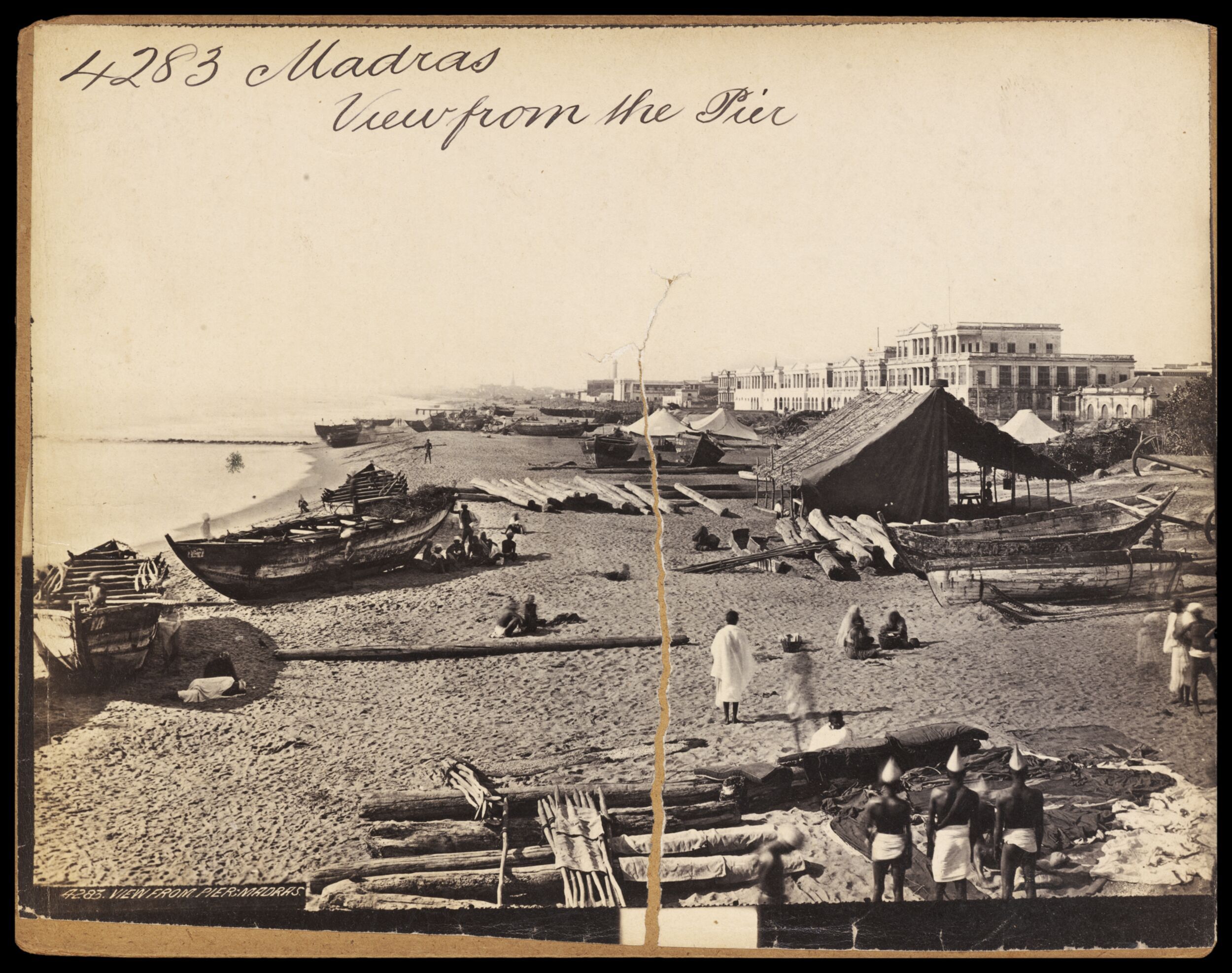
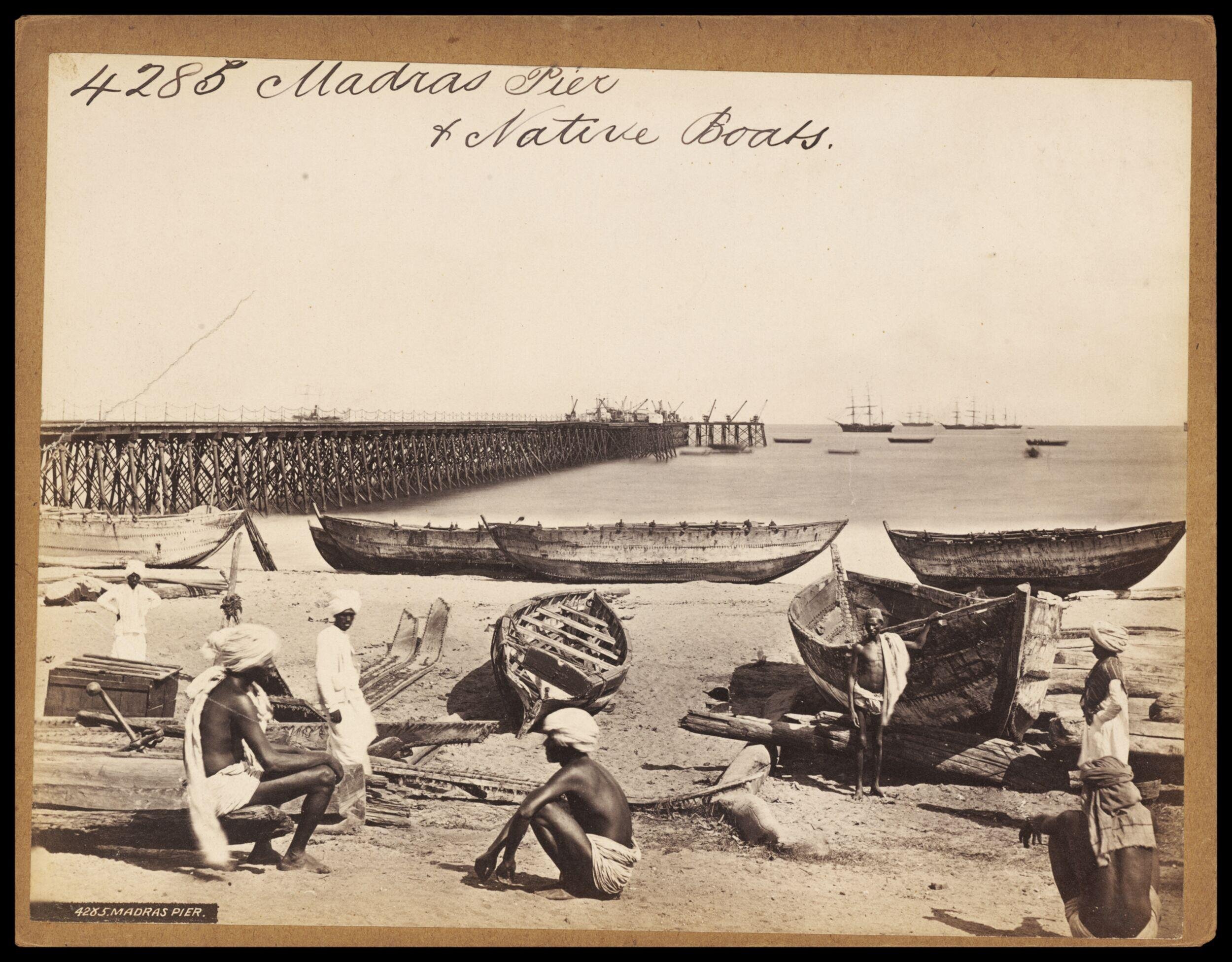
Upon surveying the port photographs in the V&A collection, specific patterns emerge. The port image highlights a persistent social imagination of the colonial territory and its hierarchical orders. I will use a few examples from the Universal Series by Francis Frith & Co. to illustrate this. These incredible photographs taken in the port of erstwhile Madras (present-day Chennai) offer a complicated tableaux. Some of them present a panoramic view taken from a higher vantage point (from possibly atop a structure akin to an outpost). The anatomy of the photo consists of ships, catamarans, native boats, the pier, bodies of different citizens, colonial buildings that are part of the promenade of Madras, as well as the horizon divided between the land, ocean and sky. However, it is the organisation of bodies and infrastructure—including the performativity of the subjects and their inherent relation to caste hierarchies—and the compositional biases of photography that are worth noticing.
In the Indian caste system, especially in Tamil Nadu, the Brahmin (the historically elite caste) had a cultural taboo around ocean travel. The ocean was looked at as the ‘unknown’, and travelling beyond it was seen as a sin. While there are records of Brahmin mobility from the land to distant waters, caste was a determining factor in maritime histories. Historically, mobility around the Indian Ocean has been across a spectrum, ranging from wealthy Muslim merchants to unprivileged, untouchable castes who were forced to migrate as part of the slave trade or indentured labour. The colonial camera has dictated the history of photographic representation by co-opting the sociological hierarchies of caste. The oppressed castes and the untouchables often had a double role to play in these photographs (to be represented and also to gesture to another colonial idea—often of performing labour, caste occupation or to provide a sense of scale).
In the photo titled “Madras Pier and Native Boats” (Fig. 9), the distance between the performativity of the orderlies in white/light clothing and the scantily clothed subjects is the difference of caste, expropriated through untouchability and unseeability. A web of relationships forms between the camera apparatus, the temporality of the photographic exposure, the performativity of the body, the social proximity of different bodies in the port, the composition of the photograph, the caste hierarchies of the society and the colonial order of photographic visuality. Thus, the exposure discloses knowledge of an internal coloniality within South Asian communities, along with the framing of the ‘native’ by the Western photographer.
From an anthropocentric lens, the port is a littoral space; it is a liminal cosmos from where the land exits and the ocean begins.
Port cities were active centres of trade, exchange and circulation. Thus, they were often the subjects of postcards, which, along with telegraphs, were active vehicles for transnational information circulation. In the collection, the standard port photograph contained colonial architecture—consisting of centres of trade, offices and estates that were responsible for controlling the logistics and trade in the port—as it overlooked the sea with the ships in the distance. Photos of many ports in the V&A collection—and particularly in the Universal Series by Francis Frith & Co.—share a similar pictorial quality. In the book Globalizing Labour? Indian Seafarers and World Shipping (2012),18 G. Balachandran argues that the photographs of the everyday life of the Indian lascars onboard the ship Viceroy of India were carefully constructed tableaux vivants. The photographs in the Viceroy of India album had a trophy-like quality that gestured to the impossibility of the humble Indian lascar donning the subject of the empire. Colonial states regulated the engagement of Indian seafarers on oceanic shipping in minute detail, rendering them invisible.
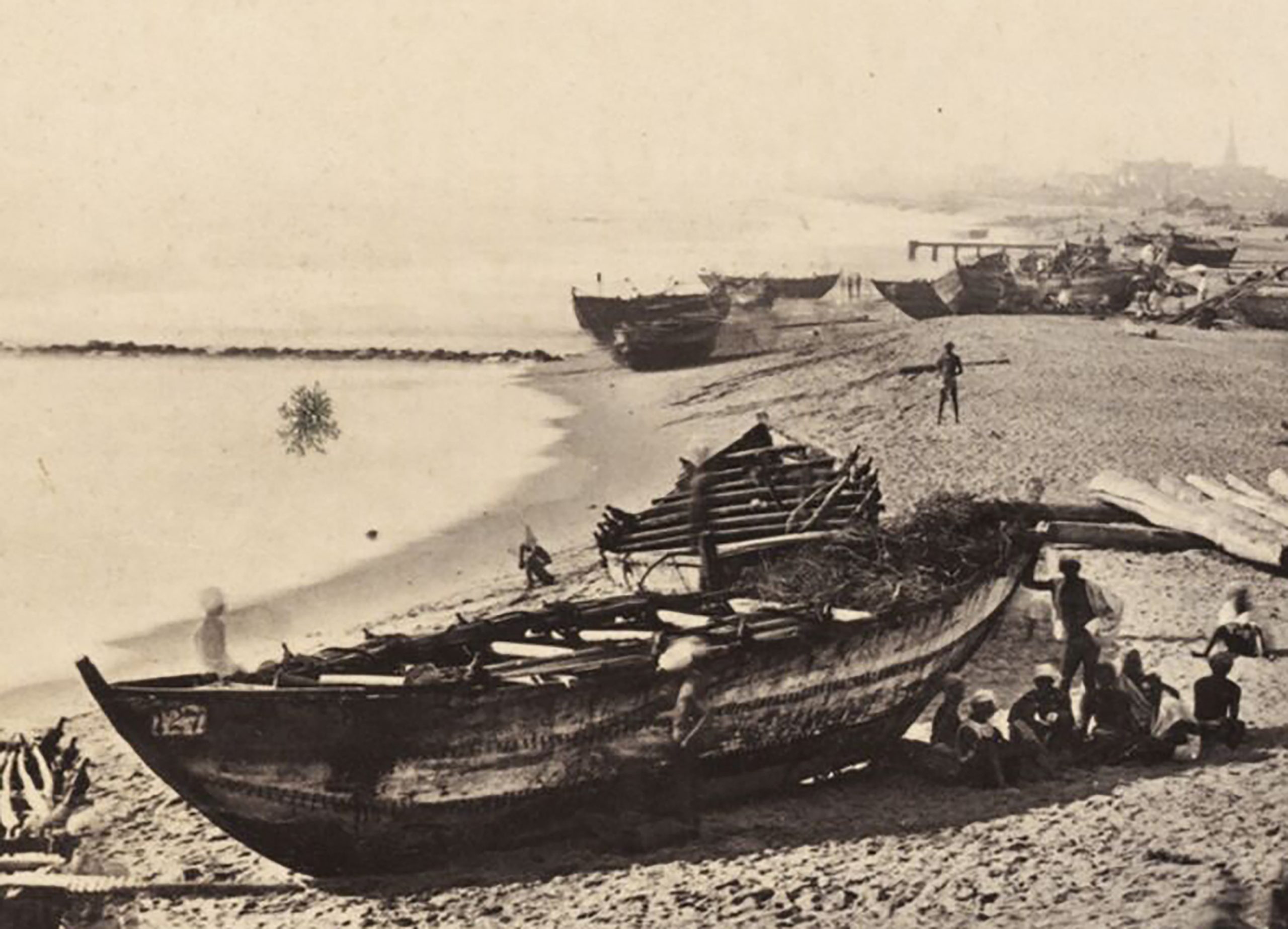
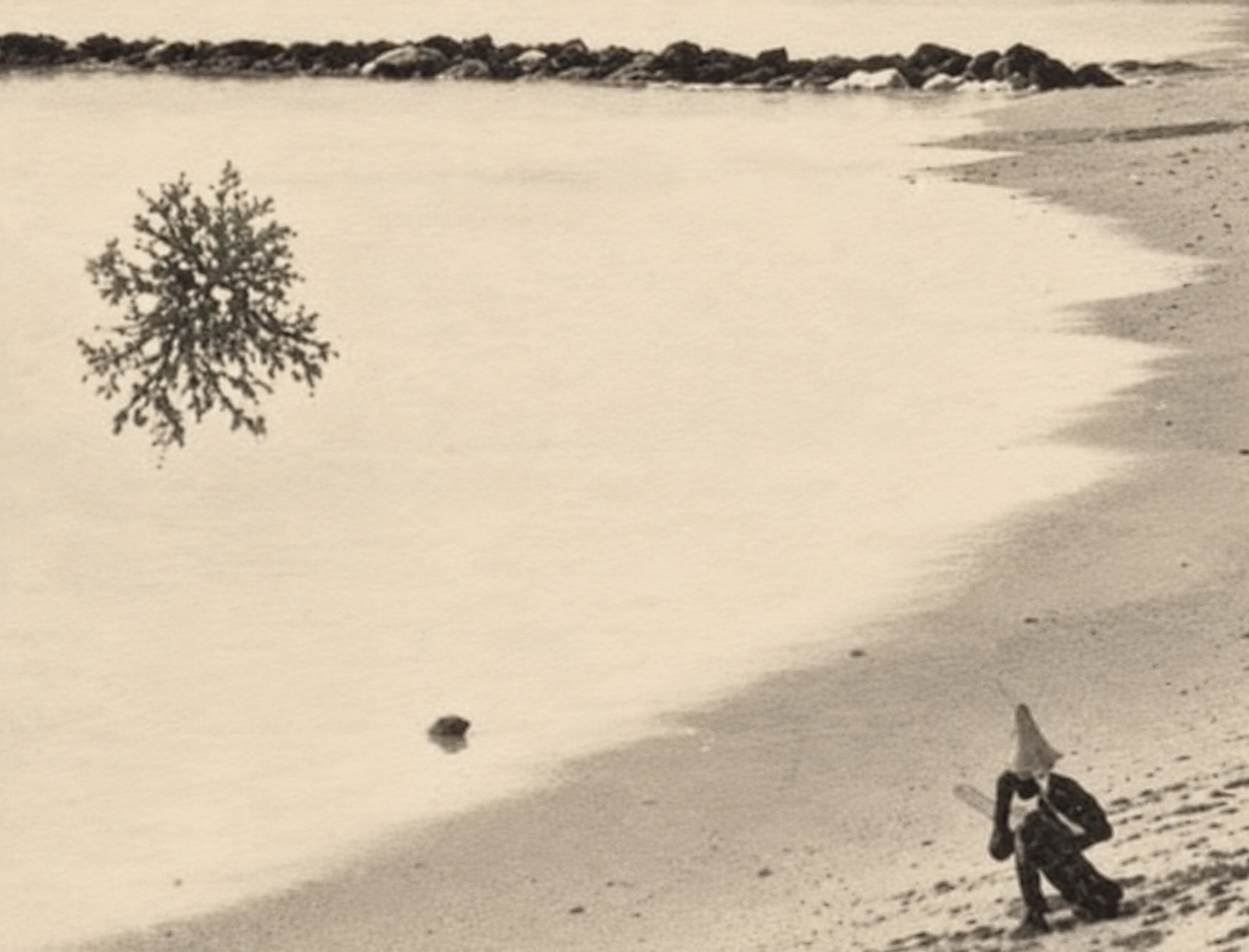
Returning to “Madras, View from the Pier” (Fig. 10), the photograph depicts many figures standing motionless—calibrating stillness to the mechanics of the camera and holding their breath to the timing of exposure. At the bottom, we see three bare-bodied figures in a line, wearing what appear to be conical hats. Towards the centre, we see a lonely figure wearing a light (presumably white) cloth. Upon surveying the surface of the photograph, one sees many seated figures, some under the shade of the catamarans, others near the timber logs and the large tent. My eyes scan these figures as they emerge from being embedded on the surface of the photograph depicting the Madras port. Upon a closer look at the periphery of the photograph, one sees the promenade on the right side and the sea on the left. A seated figure (Figs. 11 and 12) near the edge of the shore becomes the subject of my attention. Like the solitary man who pauses to polish his shoe in the Boulevard du temple,19 this sitting figure becomes the angel of history20 escaping the tableau that was constructed of the port under a colonial regime. This figure is of the utmost importance for me: the person who is looking at the sea and sits with his back to the land. Temporarily out of the orbit of the cartographies of caste and the colonial gaze, this person might have seen beyond the index of the photographic order. He seems to have fixed his vision on the horizon to avoid the seasickness of history.
1. Philip Steinberg and Kimberley Peters, “Wet Ontologies, Fluid Spaces: Giving Depth to Volume through Oceanic Thinking,” Environment and Planning D: Society and Space 33, no. 2 (April 2015), p. 247. https://doi.org/10.1068/d14148p.
2. Dilip M. Menon, Nishat Zaidi, Saarah Jappie and Simi Malhotra, Ocean as Method: Thinking with the Maritime (Routledge, 2022), p. vii.
3. Joseph-Louis Lagrange, a French mathematician, was born 25 January 1736. Lagrange worked in the field of what we now call celestial mechanics, building on the work of Isaac Newton and trying to determine exactly how bodies like planets and moons interact under their mutual gravitational attraction.
4. Philip Steinberg and Kimberley Peters, “Wet Ontologies, Fluid Spaces: Giving Depth to Volume through Oceanic Thinking,” Environment and Planning D: Society and Space 33, no. 2 (April 2015), pp. 257–58. https://doi.org/10.1068/d14148p.
5. Aníbal Quijano, “Coloniality of Power, Eurocentrism, and Latin America,” in Aníbal Quijano: Foundational Essays on the Coloniality of Power, eds. Walter D. Mignolo, Rita Segato and Catherine E. Walsh (Duke University Press, 2024), pp. 256–302. https://doi.org/10.1215/9781478059356-012.
6. Dilip M. Menon, “Oceanic Histories: From the Terrestrial to the Maritime” in Ocean as Method: Thinking with the Maritime, eds. Dilip M. Menon, Nishat Zaidi, Saarah Jappie and Simi Malhotra (Routledge, 2022), p. 15.
7. Boaz Levin, Esther Ruelfs and Tulga Beyerle, Mining Photography: The Ecological Footprint of Image Production (Spector Books, 2022).
8. Ariella Aisha Azoulay, The Civil Contract of Photography (Zone Books, 2022).
9. Roland Barthes, Mythologies, trans. Annette Lavers (Noonday Press, 1972 [1957]), p. 158.
10. Claude Lévi-Strauss, Tristes Tropiques, trans. John Weightman and Doreen Weightman (Jonathan Cape, 1973 [1955]), pp. 338–9.
11. Carl Schmitt, The Nomos of the Earth, trans. G.L. Ulmen (Telos Press Publishing, 2006 [1974]), p. 143.
12. Gustave Le Gray (1820–1884) pioneered combination printing, a technique that allowed him to overcome the technical limitations of mid-19th-century photographic emulsions, which could not properly expose both the bright sky and the darker sea in a single shot.
13. Michel Foucault, “Of Other Spaces, Heterotopias” Translated from Architecture, Mouvement, Continuité no. 5 (1984): pp. 46–49.
14. It is to be noted that both photography and the steam engine were early 19th century inventions which had profound effects on time, cartography and the circulation of information between the empire and colonies.
15. James Dugan, The Great Iron Ship (Harper & Brothers, 1953), pp. 222–24; 240.
16. Nidhi Mahajan, Moorings: Voyages of Capital Across the Indian Ocean (University of California Press, 2025).
17. See Renisa Mawani in Across the Ocean of Law, 2018; and Edouard Glissant in Poetics of Relation, 1990.
18. Gopalan Balachandran, Globalizing Labour? Indian Seafarers and World Shipping, c. 1870–1945 (Oxford University Press, 2012).
19. “Boulevard du Temple” is a photograph of a Parisian streetscape made in 1838 (or possibly 1837), and is one of the earliest surviving daguerreotype plates produced by Louis Daguerre, one of the inventors of photography. Although the image seems to be of a deserted street, it is widely considered to be the first photograph to include an image of a human. It accidentally captures a bootback and his customer.
20. Walter Benjamin, Theses on the Philosophy of History (1940).
——————————————————————————————————————–
Copy Editing: Mallika Visvanathan